Language “the feast of human thought”
Yesterday, my good friend and neighbor “Charlie” was telling me a story about his work days. I don’t remember all the details of the story because, at one point, out of nowhere, he tossed an expression onto the table like a dealer throwing down a winning card.
“Like a pisshole in the snow.”
The moment those words hit my ears, I was gone.
Not gone physically. I was still standing there listening. But my mind had already wandered off to one of my favorite places. It was like catching the scent of a boiled dinner simmering in a crockpot and following it into the kitchen. I knew if I chased the thought too far, I’d miss the rest of Charlie’s story, so I parked the expression for later.
Well, later has arrived.
Here I am standing in the kitchen of memory, staring into a pot of alphabet soup, trying to figure out why a crude old expression can make me so happy.
The phrase is usually used to describe someone whose eyes are shrunken, bloodshot, watery, or exhausted. Maybe they’re hungover. Maybe they’re tired. Maybe life has just been giving them a good working over.
I’ve heard dozens of expressions like it over the years.
“Not worth a rat’s ass.”
“Busier than a one-armed paper hanger.”
“Madder than a wet hen.”
Some people hear vulgarity. I hear poetry.
Not the kind of poetry you’ll find in a college textbook. The kind hammered together by laborers, bartenders, mechanics, cops, veterans, factory workers, and mothers trying to stretch a paycheck through the week.
These expressions carry color. They carry texture. They turn an ordinary story into something you can see, smell, and almost touch. They take what would otherwise be a simple outline and fill it with life.
Every time I hear one, I find myself thinking about a question that gets asked from time to time:
“If you could invite anyone, living or dead, to dinner, who would it be?”
People usually answer with presidents, movie stars, inventors, saints, or famous writers.
My answer is much simpler.
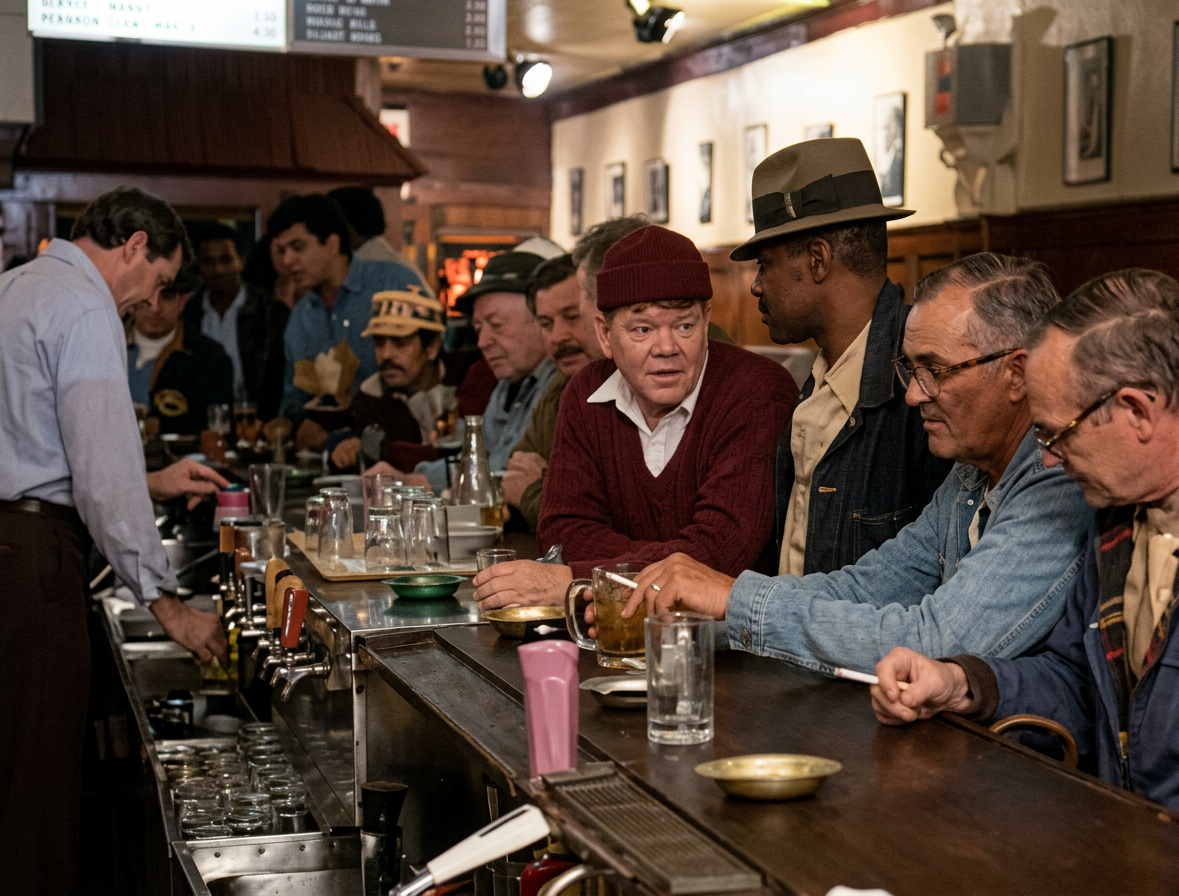
I’d like a booth midway down the bar at Charlie’s Tap in Cambridge on a Friday night during payday.
My guests would be a mixture of blue-collar and white-collar workers. Men and women fresh from factories, offices, construction sites, service stations, and storefronts. Some with ties loosened around their necks. Some with work boots still covered in dust.
The conversation would bounce from the dog track to politics, from work to war stories, from family troubles to family triumphs. Every subject imaginable would eventually find its way to that booth.
The stories weren’t always pretty.
Some were sad.
Some were outrageous.
Some probably improved with every retelling.
But they almost always ended the same way—with laughter.
The secret ingredient wasn’t the story itself. It was the language. The seasoned expressions tossed into the mix by people like Charlie who had lived hard, worked hard, and somehow found a way to laugh about it all.
I was lucky enough to grow up around those conversations.
My mother tended bar at Charlie’s Tap.
My brother Charlie worked the kitchen.
As a kid, I never had to pay for the meals. They were always on the house.
Looking back, though, the food wasn’t the greatest gift I received there.
The real meal was the conversation.
Every plate came with a side order of stories.
Every storyteller left a tip.
And after all these years, I still find myself collecting them.
Served hot or cold.


I heard every one of those expressions in my house, growing up. My mother, being a bit more of a lady, used the word peehole. 😀 😎
LikeLiked by 1 person